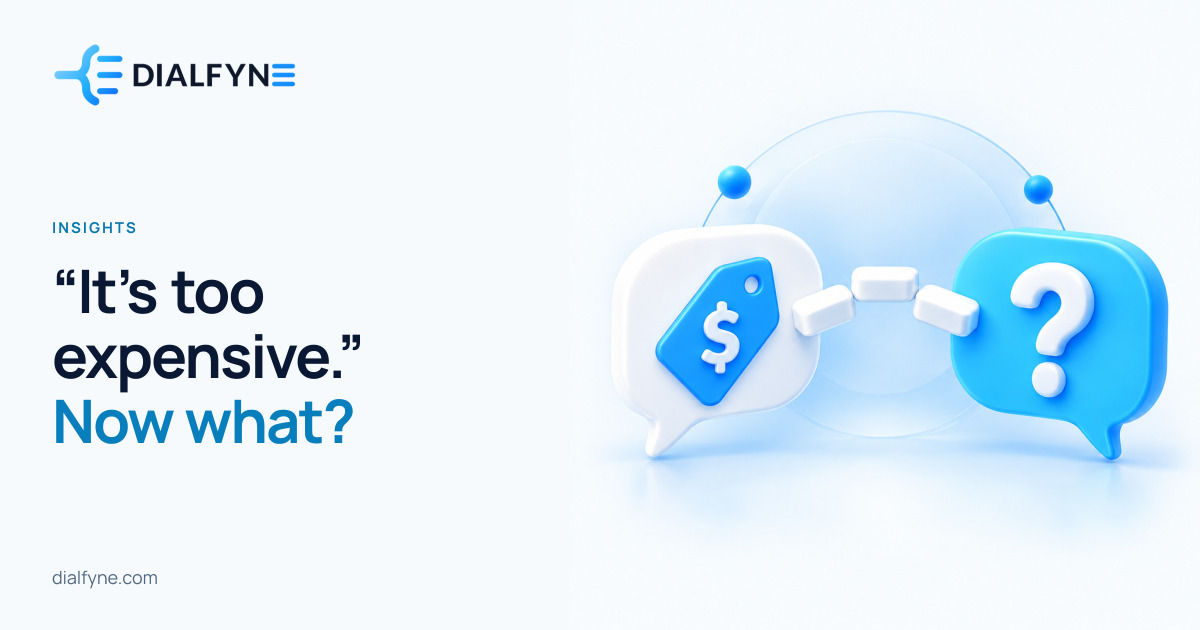
"That is more than we expected to pay." Every rep has heard it. Most reps panic, offer a discount, or launch into a feature list. None of those work. The reps who consistently close deals at full price do something different: they reframe the conversation from cost to value, and they do it without sounding defensive.
This post gives you 8 specific responses for the most common price objections. Each one is designed to keep the conversation alive, surface the real concern, and move the deal forward. Practice them with AI before you need them on a live call.
The 8 price objections and how to handle them
1. "That is too expensive."
Response: "I understand budget is a factor. Can I ask — compared to what? Are you comparing this to doing nothing, to a competitor, or to a different approach entirely?" This surfaces whether the objection is about budget, competition, or perceived value.
2. "We do not have budget for this."
Response: "Got it. Can I ask what [problem] is currently costing you per month? Sometimes the math changes when we look at the full cost of the status quo." This reframes around the cost of inaction.
3. "Your competitor is cheaper."
Response: "That makes sense. Price matters. Can I ask what you are comparing — the monthly fee, or the total cost including setup, training, and the outcomes you actually need?" This shifts from sticker price to total cost of ownership.
4. "We need to think about it."
Response: "Absolutely. What specifically do you need to think through — the price, the timing, or something else?" This prevents the deal from dying in "think it over" limbo.
5. "Can you do any better on price?"
Response: "I want to make sure we are comparing the right things. If we can show you [specific outcome] within [timeframe], would the price feel different?" This ties price to value before discussing numbers.
6. "We are going with the cheapest option."
Response: "That is a valid approach. Can I ask what happens if the cheapest option does not deliver [specific outcome]? Is there a plan B, or does the problem continue?" This introduces risk without attacking the competitor.
7. "The finance team will never approve this."
Response: "Understood. What does finance need to see to approve an investment like this? If we can build a business case showing [specific ROI], would that help?" This turns a blocker into an action item.
8. "We will revisit this next quarter."
Response: "I will put that on my calendar. What specifically will be different next quarter — budget, timing, or priorities?" This tests whether it is a real delay or a polite no.
The psychology of price objections
Price objections are rarely about price. They are about uncertainty. The prospect does not yet believe the value exceeds the cost. Your job is not to defend the price — it is to increase certainty about the outcome.
The fastest way to increase certainty is to quantify the problem. If you have already surfaced that the prospect loses $8,200 per month to missed calls, a $2,000 solution is not expensive — it is a 4x return. But if you skipped discovery and jumped straight to proposal, the price feels high because the value is undefined.
“The reps who win on price are not the ones who discount. They are the ones who do such thorough discovery that the prospect already knows the cost of inaction before the price is mentioned.”
Practice price objections with AI
AI roleplay is the only way to practice price objections at volume. In a live call, you get one shot. In AI practice, you get 50. Dialfyne's objection handling scenario features a buyer who keeps returning to price no matter what you say. You have to stay composed, ask the right questions, and refuse to discount reflexively.
After each session, you get scored on whether you surfaced the real objection, maintained control of the conversation, and avoided giving away margin. Reps who practice this scenario 20 times report significantly more confidence on live price calls.