An enterprise AE spends three weeks on a deal. Four discovery calls, two demos, a security review, and a pricing negotiation. The prospect goes dark. Two months later, the AE learns the deal went to a competitor. The post-mortem reveals the same pattern every time: the discovery was shallow. The AE never surfaced the real business problem, never identified the internal competition, and never established why the prospect had to buy now rather than next quarter.
Discovery is where enterprise deals are won and lost. Not in the demo. Not in the proposal. In the first 15 minutes of the first discovery call, when the AE either earns the right to ask hard questions or gets relegated to "just another vendor." Most AEs get fewer than 5 live discovery practice sessions before they are expected to run million-dollar pipelines. AI roleplay changes that math.
Why enterprise discovery is harder than it looks
Enterprise discovery is not about asking "What keeps you up at night?" It is about navigating complex organizational dynamics, uncovering hidden priorities, and building trust with buyers who have been burned by vendors before. The enterprise buyer is not a single person. It is a committee with competing incentives, internal politics, and conflicting definitions of success.
The economic buyer cares about ROI and risk. The technical buyer cares about integration and compliance. The end user cares about workflow and usability. The champion cares about career impact. A discovery call that addresses only one of these stakeholders produces a proposal that gets blocked by the others. The AE who wins is the one who maps the full committee and tailors the conversation to each player.
What AI discovery practice actually simulates
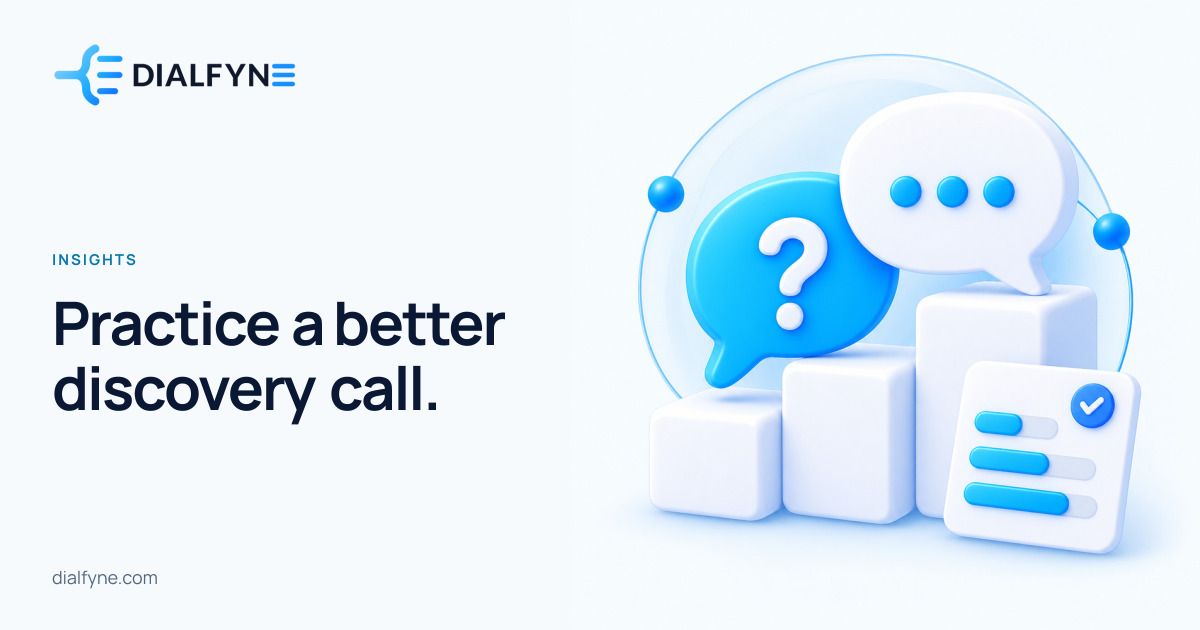
Dialfyne's AI discovery scenarios are built from real enterprise sales transcripts. The AI buyer has a detailed persona, a company context, a current state, and a hidden motivation. The AE must ask the right questions to surface pain, identify stakeholders, and establish urgency. The AI reacts in real time, challenging vague questions, deflecting premature pitches, and testing whether the AE actually listens.
The scoring is not subjective. The AI evaluates specific behaviors: Did the AE ask open-ended questions before making assertions? Did they surface a quantifiable business problem? Did they identify at least three stakeholders? Did they establish a timeline and next steps? Did they avoid pitching before understanding pain? Each session produces a scorecard with precise feedback and trend data over time.
The four discovery skills AI practice builds
1. Pain identification
Most AEs accept surface-level pain. "We need better reporting" or "Our current tool is slow." Real pain is specific, quantified, and tied to a business outcome. AI practice trains AEs to keep asking until they get to the root cause: "Slow reporting means your team spends 12 hours per week on manual data consolidation, which means your quarterly close is delayed by 4 days, which means your CFO cannot present accurate numbers to the board on time." The AI only gives up the deep pain if the AE asks layered questions.
2. Stakeholder mapping
Enterprise deals die in committee. AI practice simulates the buying committee by requiring the AE to ask about decision-makers, influencers, and blockers. The AI buyer reveals different information based on whether the AE asks directly ("Who else is involved?") or indirectly ("How does your team currently handle X?"). The scorecard tracks whether the AE mapped the full committee and whether they proposed a multi-stakeholder next step.
3. Urgency creation
Without urgency, enterprise deals stall. AI practice teaches AEs to find compelling events: regulatory deadlines, board meetings, competitive threats, or internal initiatives with fixed timelines. The AI buyer has a hidden compelling event. The AE must ask timeline questions and consequence questions to surface it. The scorecard evaluates whether the AE established a specific deadline and why missing it would be costly.
4. Next-step control
Weak AEs end discovery calls with "Let me send you some materials" or "I will circle back next week." Strong AEs book the next meeting before hanging up. AI practice scores whether the AE proposed a specific next step with a date, time, and agenda. The AI buyer resists vague proposals and only commits to concrete next steps. This trains AEs to maintain momentum rather than letting deals drift.
How enterprise teams use AI discovery practice
The most effective implementation is weekly structured practice plus targeted reinforcement. Every Monday, AEs run a 20-minute AI discovery scenario focused on the persona they will face that week. After live calls, managers review the AI scorecards alongside actual call recordings to identify patterns. AEs who struggle with stakeholder mapping practice committee scenarios. AEs who lose deals to "no urgency" practice timeline and consequence questions.
“Enterprise AEs who practice discovery with AI 3+ times per week show 28% higher win rates and 19% shorter sales cycles than AEs who practice less than once per month. The improvement is not marginal. It is the difference between making quota and missing it.”